

Category: Uncategorized

  • A breast pump flange size guide for comfort and output

    A breast pump flange size guide for comfort and output

    Meredith Calloway
    Written by
    Meredith Calloway
    Pumping & Parenting Content Lead
    10 Jul 20269 min read

    Getting flange fit right is one of the most overlooked parts of pumping, yet it affects almost everything: how comfortable each session feels, how efficiently milk is removed, and how well your supply responds over time. A breast pump flange size guide is not just a sizing chart — it is a practical framework for understanding what is happening inside the tunnel during a pump session and how to adjust it so pumping actually works for your body. This article walks through how to measure, what to look for, what commonly goes wrong, and when it is time to resize.

    What breast pump flange size guide means in practice

    The flange is the funnel-shaped cup that fits against your breast and draws your nipple into the tunnel during pumping. Flange size refers specifically to the diameter of that tunnel opening — the part your nipple moves into — and it is measured in millimeters. Most pumps come with one or two default sizes, but those sizes are not designed to fit everyone. They are a starting point.

    A breast pump flange size guide helps you figure out which tunnel diameter allows your nipple to move freely without pulling in too much surrounding areola tissue. When the fit is right, the nipple moves in and out of the tunnel rhythmically, milk flows, and there is no pinching, rubbing, or blanching. When the fit is off, you feel it — and your output often reflects it.

    Understanding breast pump flange fit matters because nipple size varies significantly from person to person, and it can also change across the postpartum period as swelling decreases and tissue shifts. A size that felt fine at two weeks postpartum may not be the right size at two months. Treating flange sizing as a one-time decision rather than an ongoing check is one of the most common reasons pumping parents struggle without knowing why.

    If you want a quick starting point before reading further, the flange sizing guide on the Olivia site walks through the measurement process with a visual reference.

    How to think about breast pump flange size guide

    Flange sizing is not about finding the biggest or smallest option — it is about finding the one that matches your nipple diameter with a small amount of clearance. The goal is a fit that allows movement without friction and without excess tissue being pulled in. Getting to that fit requires understanding a few core concepts and knowing which signals to pay attention to.

    The core problem to understand
    The core problem to understand for breast pump flange size guide

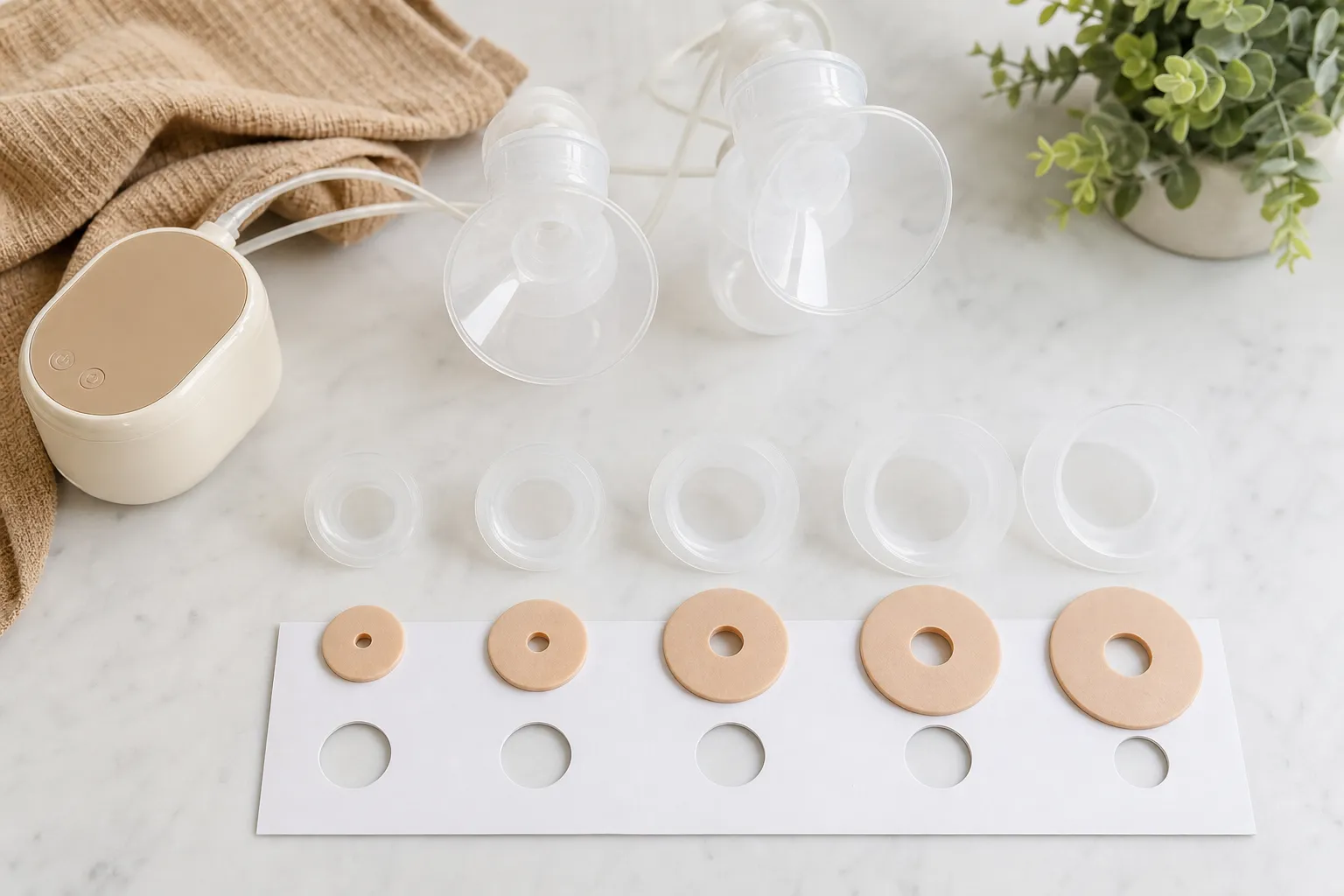
    The most fundamental issue with flange fit is that most people size based on bra size or breast size, neither of which is relevant. Flange size is determined by nipple diameter alone — specifically the diameter of the nipple shaft at its base, not the areola and not the tip.

    To measure, use a soft measuring tape or a printed nipple ruler. Measure across the widest point of your nipple at the base, in millimeters. That number is your nipple diameter. Your flange size should be approximately 2 to 4 millimeters larger than that measurement. This small gap allows the nipple to move freely during the pumping cycle without the tunnel walls pressing against the shaft.

    The reason this matters so much is that the pumping motion works by creating a vacuum that draws the nipple in and releases it repeatedly. If the tunnel is too narrow, the nipple rubs against the walls, causing friction, soreness, and sometimes reduced milk flow because the tissue cannot move properly. If the tunnel is too wide, too much areola tissue gets pulled in, which can cause swelling, bruising, and reduced output because the suction is not being applied where it needs to be.

    Elastic nipples add another layer of complexity. Some nipples stretch significantly under suction, meaning a nipple that measures 16mm at rest may effectively behave like an 18mm or 20mm nipple during pumping. If you measure and use the standard formula but still experience discomfort or poor output, elasticity may be a factor. In those cases, some parents find that sizing down slightly — rather than up — creates a better functional fit, because the tunnel provides more support and reduces the amount of stretch. This is worth exploring with a lactation consultant if standard sizing is not resolving the issue.

    The practical decision criteria

    The practical decision criteria for breast pump flange size guide

    Once you have your measurement, the next step is evaluating fit in real time during a pump session. Numbers give you a starting point, but what you observe during pumping tells you whether the fit is actually working.

    Signs of a good breast pump flange fit include: the nipple moves in and out of the tunnel without touching the sides, there is little to no areola tissue being pulled in, the skin color stays normal throughout the session, and there is no pain, pinching, or soreness during or after pumping. Milk should flow steadily, and the session should feel manageable — not something you dread.

    Signs the flange is too small: the nipple rubs against the tunnel walls, you feel pinching or friction, the nipple tip may appear white or blanched after pumping, and sessions are consistently painful. Output may be lower than expected because restricted movement limits milk removal.

    Signs the flange is too large: you can see areola tissue being pulled into the tunnel, the skin around the nipple looks swollen or red after sessions, and output may be lower because the suction is dispersed across too much tissue rather than focused on the nipple and ducts.

    For parents using a wearable breast pump, flange fit is especially important because the pump sits against the body inside a bra, meaning there is no way to visually check what is happening mid-session. Getting the fit right before you start moving around with a wearable pump prevents discomfort from building unnoticed over a full session.

    Common mistakes to avoid

    Common mistakes to avoid for breast pump flange size guide

    The most common mistake in any breast pump flanges size guide situation is defaulting to whatever size came in the box. Standard included flanges are typically 24mm or 25mm, which fits a portion of the population but not everyone. Many people — particularly those with smaller nipple diameters — are using flanges that are too large without realizing it.

    A second common mistake is measuring once and never revisiting. Nipple size can change in the early weeks postpartum as swelling from birth and initial engorgement resolves. A flange that fit well at one week may be too large by week four. If your output drops or discomfort increases without an obvious cause, re-measuring is a reasonable first step.

    A third mistake is ignoring asymmetry. It is entirely normal for nipples to differ in size between breasts. Using the same flange size on both sides when there is a meaningful size difference means at least one side is not optimally fitted. Many pumps allow for different flange sizes on each side, and using that flexibility is worth considering.

    Finally, some parents assume that more suction will compensate for a poor fit. It will not. Increasing suction on an ill-fitting flange typically increases discomfort and can cause tissue damage. Fit should always be addressed before adjusting suction levels.

    How to apply this to breast pump flange size guide

    Putting this into practice is more straightforward than it might seem. Start by measuring your nipple diameter in millimeters. Add 2 to 4 millimeters to get your starting flange size. If your pump offers that size, try it for a full session and observe the fit criteria described above.

    If the fit feels close but not quite right, adjust by one size in either direction and observe again. Give each size at least two or three sessions before drawing conclusions, since the first session with a new size can feel unfamiliar even when the fit is correct.

    Keep a simple mental checklist for each session: Is the nipple centered? Is it moving freely without touching the walls? Is any areola tissue being pulled in? Is there pain? Is milk flowing? These five questions will tell you more than any chart alone.

    If you have elastic nipples and standard sizing is not working, consider consulting a lactation consultant who can observe a session and give personalized guidance. Silicone inserts are also available for some pump models and can effectively reduce the tunnel diameter without replacing the flange entirely — a useful option if you are between sizes.

    When you are ready to think about which pump to pair with your correctly sized flanges, Olivia by Lolafo offers wearable pump options designed with everyday portability in mind, and compatibility with multiple flange sizes is part of what makes a pump practical for real-life use.

    Revisit your flange size any time you notice a change in comfort or output. Pumping is not static, and your fit should be treated as something to check periodically rather than set and forget.

    FAQ about breast pump flange size guide

    Is it better to have a flange too big or too small?

    Neither is ideal, but a flange that is slightly too small is often more immediately noticeable because it causes pain. A flange that is too large may reduce output gradually without obvious discomfort, making it easier to miss.

    What flange size is most common?

    The 24mm size is frequently included as a default and fits a broad range of nipple diameters, but it is not universally correct. Many people need sizes ranging from 19mm to 27mm depending on individual anatomy.

    What do nipples look like if the flange is too big?

    The nipple may appear swollen or puffy after a session, and you may notice areola tissue has been pulled into the tunnel during pumping. Redness or a ring of irritation around the base of the nipple can also indicate the flange is too large.

    What should readers know first about breast pump flange size guide?

    Flange size is based on nipple diameter, not breast size or bra size. Measuring your nipple in millimeters and adding 2 to 4mm gives you a reliable starting point for finding the right breast pump flange fit.

    How do you choose the right breast pump flange size guide approach?

    Measure first, then observe fit during a real session. Use the visual and comfort cues — nipple movement, areola pull-in, pain, and output — to confirm whether the size is working or needs adjustment.

    What mistakes should you avoid with breast pump flange size guide?

    Avoid assuming the included flange size is correct, ignoring differences between sides, and trying to fix a poor fit by increasing suction. Address fit first, then fine-tune suction settings once the flange is properly sized.

    Is breast pump flange size guide worth it for daily use?

    Yes. Correct flange fit directly affects comfort and milk output during every session. Taking time to size properly at the start saves significant discomfort and guesswork over weeks or months of pumping.

    What should you compare before deciding on breast pump flange size guide?

    Compare your measured nipple diameter against available flange sizes, then compare how each size performs during an actual session using fit cues like nipple movement, areola pull-in, and comfort level.

    The most useful thing you can do after reading this is measure your nipple diameter today if you have not already. It takes less than two minutes and gives you a concrete number to work from rather than guessing based on how a session feels.

    From there, use the flange sizing guide to match your measurement to the right size range and see whether your current flange is in the right zone. If it is not, that single change may make a noticeable difference in both comfort and output.

    If you are still in the process of choosing a pump, keep breast pump flange fit in mind as a compatibility factor. A pump that supports a range of flange sizes — and that makes it easy to swap them — gives you more flexibility to get the fit right and adjust as your needs change. Getting the fit right is not a one-time task, but once you know what to look for, it becomes a quick and reliable part of your pumping routine.

    Meredith Calloway
    About the author
    Meredith Calloway
    Pumping & Parenting Content Lead

    Meredith spent three years exclusively pumping for two kids while working full-time as a labor and delivery nurse, which means she has strong opinions about flange fit, battery life, and anything that claims to be ‘whisper quiet.’ She now channels that hard-won knowledge into content that cuts through the marketing fluff and gives pumping parents the honest, specific information they actually needed at 2 a.m. Her writing lives at the intersection of clinical accuracy and real-world chaos — because knowing the let-down physiology is only useful if you also know how to clean pump parts with one hand. At Olivia by Lolafo, she covers everything from choosing your first wearable to troubleshooting a stubborn supply dip.


    Wearable pump comparisons and real-world tradeoffsExclusive pumping routines and schedulesMilk storage and handling best practicesReturning to work while pumpingFlange fit and output troubleshootingBreastfeeding product reviews
  • A step-by-step way to benchmark competitors in AI search

    A step-by-step way to benchmark competitors in AI search

    Dana Merritt
    Written by
    Dana Merritt
    Lead SEO & AI Search Strategist
    17 Jun 20264 min read
    Start with the outcome you actually need for how to do competitor benchmarking

    1. Start with the outcome you actually need

    Before you touch any tool or spreadsheet, decide what a win actually looks like. Are you trying to show up more often when buyers ask AI platforms to recommend vendors in your category? Or do you want to know why a specific competitor keeps getting cited and you don’t? Knowing the answer shapes every other decision.

    Pick one narrow goal first — for example, “track our share of voice versus two direct competitors across 20 buying-intent queries on ChatGPT and Perplexity.” That is specific enough to act on. Vague goals produce vague data.

    If you’re still figuring out which tools fit this kind of work, the upcoming guide on competitor benchmarking tools covers the main options worth evaluating.

    Set up the simplest workable system for how to do competitor benchmarking

    2. Set up the simplest workable system

    You need three things before you start collecting data: a defined query set, a defined competitor list, and a way to record results consistently.

    • Query set: 15–30 prompts that real buyers would type into an AI platform at the consideration stage (“best [category] tools for [use case],” “compare [category] vendors,” etc.)
    • Competitor list: 3–5 brands, not 20
    • Tracking method: a shared spreadsheet or a dedicated ai search analytics platform — whichever your team will actually maintain

    The biggest mistake here is starting with too many queries or too many competitors. You end up with a dataset nobody has time to interpret. Start small, prove the process works, then expand.

    Follow the process without overcomplicating it for how to do competitor benchmarking

    3. Follow the process without overcomplicating it

    This is the core loop for how to do competitor benchmarking in AI search:

    1. Run each query in your set across the AI platforms you care about (ChatGPT, Perplexity, Gemini, or whichever are relevant to your audience).
    2. Record whether your brand is mentioned, where in the response it appears, and whether it is cited as a source.
    3. Do the same for each competitor.
    4. Calculate share of voice: how often each brand appears across the full query set, expressed as a percentage of total mentions.

    If you’re doing this manually, batch it weekly. If you’re using a competitor benchmarking tool or an ai search analytics platform, you can automate the data collection and focus your time on interpretation. The goal is a consistent cadence — not a one-time audit.

    Check what is working and what is not for how to do competitor benchmarking

    4. Check what is working and what is not

    After two to four weeks of data, look for patterns rather than individual data points. A single query result means almost nothing. Trends across 20+ queries over time tell you something real.

    Questions worth asking at this stage:

    • Which query types consistently surface competitors but not you?
    • Are competitors being cited from specific domains or content types you don’t have?
    • Is your mention rate improving, flat, or declining week over week?

    The value of using ai search analytics here is that it removes the manual noise. But even in a spreadsheet, you can spot the gaps if your query set is focused. Avoid the trap of optimizing for queries where you already appear — the opportunity is in the gaps.

    Adjust when your situation changes for how to do competitor benchmarking

    5. Adjust when your situation changes

    Benchmarking is not a set-and-forget process. A few situations that should trigger a reset:

    • A competitor launches new content or a product that changes how AI platforms describe your category
    • You publish a major piece of content and want to measure whether it shifts your visibility
    • A new AI platform becomes relevant to your buyers and you need to search monitor competitors there too

    When any of these happen, update your query set to reflect the new landscape. Don’t just add queries — retire ones that are no longer relevant. A bloated query set is harder to act on than a tight, current one.

    The same logic applies to your competitor list. If a new entrant starts appearing frequently in AI responses, add them. If a former rival has faded from results, drop them and use that slot for someone who matters now.

    FAQ about how to do competitor benchmarking

    What should readers know first about how to do competitor benchmarking?

    Start with a specific goal and a small query set. Broad benchmarking without a clear question produces data that’s hard to act on.

    Match the approach to your resources. Manual tracking in a spreadsheet works for small query sets; a dedicated ai search analytics tool makes sense when you need consistent, scalable data across multiple platforms.

    What mistakes should you avoid with competitor benchmarking?

    The most common mistake is tracking too many queries or competitors at once. It creates noise. Keep your scope tight until the process is running reliably, then expand.

    Is regular competitor benchmarking worth the ongoing effort?

    Yes, if you act on the findings. Benchmarking that sits in a dashboard without changing your content or positioning strategy has no return. The cadence matters less than what you do with the data.

    What should you compare before deciding on a competitor benchmarking approach?

    Compare how each approach handles data consistency, platform coverage, and your team’s capacity to maintain it. A competitor benchmarking tool that automates collection is only useful if someone reviews the output regularly. —

    The process above gives you a working foundation for how to do competitor benchmarking in AI search without overbuilding it. The next practical step is choosing how you’ll collect data at scale — manually or with a tool built for this.

    To compare the main options for teams that want to search monitor competitors across AI platforms, the upcoming article on competitor benchmarking tools walks through what to look for and how to evaluate fit. Start there once your query set and competitor list are defined.

    Dana Merritt
    About the author
    Dana Merritt
    Lead SEO & AI Search Strategist

    Dana has spent the last decade in organic search, most recently focused on how AI-generated answers are reshaping brand visibility at the top of the funnel. She’s run SEO programs for mid-market SaaS companies and agency clients, which means she’s had to justify every tool spend with actual numbers — not vendor dashboards. Her writing starts with data, names what’s working and what isn’t, and skips the fluff that pads out most industry content. If a tactic doesn’t hold up under scrutiny, she’ll say so.

    AI search visibility trackingcompetitor benchmarking in LLMsSEO measurement and reportingChatGPT and Perplexity optimizationSaaS content strategy
  • Which LLM optimization tools actually improve visibility?

    Which LLM optimization tools actually improve visibility?

    Best overall fit for ai visibility tools

    1. Best overall fit: dedicated AI search analytics platforms

    Platforms built specifically for AI search analytics give marketing teams the clearest picture of how their brand appears across ChatGPT, Perplexity, Gemini, and similar surfaces. They track mention frequency, benchmark visibility against competitors, and surface the prompts where your brand does or does not appear. That combination of evidence, benchmarking, and reporting is what separates them from generic AI content tools.

    If you want one category that covers the full workflow — measure, compare, act — a purpose-built AI visibility tools platform is the most defensible starting point. The tradeoff is that these platforms tend to cost more than point solutions, and the value compounds over time rather than delivering instant wins.

    Best for value-focused readers for ai visibility tools

    2. Best for value-focused readers: SEO platforms adding AI monitoring features

    Established SEO platforms have begun layering AI visibility monitoring onto their existing rank-tracking and content tools. For teams already paying for one of these platforms, the incremental cost to access AI search data can be low or zero, making them the best ai visibility tool option for budget-conscious buyers.

    The compromise is depth. These features are often newer additions rather than core products, so benchmarking against competitors and prompt-level reporting tend to be thinner than what a dedicated platform provides. They work well for teams that need a directional signal rather than a rigorous measurement program.

    Best for a specific use case for ai visibility tools

    3. Best for a specific use case: LLM content optimization tools

    Some tools focus almost entirely on the optimization side — helping writers structure content, add authoritative sourcing, and use language patterns that LLMs are more likely to surface in answers. These are among the best llm optimization tools for ai visibility when the primary goal is improving content before it is published rather than measuring what is already live.

    The gap is evidence. Most tools in this category do not provide analytics showing whether the optimized content actually increased AI mentions. Teams using them should pair the workflow with a separate measurement layer, or accept that they are operating on best-practice assumptions rather than confirmed outcomes.

    Best if you want fewer tradeoffs for ai visibility tools

    4. Best if you want fewer tradeoffs: platforms combining optimization and analytics

    A smaller set of top rated ai visibility optimization software products attempts to handle both workflows in one product — content guidance on the input side and visibility measurement on the output side. For teams that want to avoid stitching together separate tools, this category reduces operational friction and makes it easier to connect content changes to measurable shifts in AI mention rates.

    The narrower tradeoff here is flexibility. Combined platforms make opinionated choices about how both workflows should run, which can feel constraining for teams with established processes. They suit buyers who are starting fresh more than teams migrating from mature existing stacks.

    Best option to skip if it does not match your needs for ai visibility tools

    5. Best option to skip if it does not match your needs: generic AI writing assistants

    General-purpose AI writing tools are sometimes positioned as ai visibility tools, but they are not. They help produce content faster, not appear more often in AI-generated answers. There is no benchmarking, no competitor comparison, and no reporting on how your brand is actually represented across LLM platforms.

    If a vendor cannot clearly explain how their product measures your visibility or benchmarks it against competitors, treat it as a content production tool, not an optimization or analytics solution. Buying it as the latter is the most common mismatch in this category.

    FAQ about ai visibility tools

    What should readers know first about ai visibility tools?

    The category splits into two distinct workflows: optimization (improving content so LLMs cite you) and analytics (measuring whether they do). The best ai visibility tool for your team depends on which gap you need to close first.

    How do you choose the right ai visibility tools approach?

    Start by identifying whether your primary problem is measurement or content quality. If you cannot currently see how often your brand appears in AI answers, prioritize analytics. If you have data but weak content, prioritize optimization.

    What mistakes should you avoid with ai visibility tools?

    The most common mistake is treating a content production tool as one of the best llm optimization tools for ai visibility. If a tool cannot show you benchmark data or prompt-level reporting, it is not solving a visibility problem.

    Is ai visibility tools worth it for daily use?

    For active marketing teams managing brand presence across multiple AI platforms, yes. Top rated ai visibility optimization software surfaces changes in brand mention patterns that would otherwise go undetected until they affect pipeline.

    What should you compare before deciding on ai visibility tools?

    Compare whether each platform provides prompt-level reporting, competitor benchmarking, and coverage across the specific AI platforms your audience uses. Those three criteria separate purpose-built ai visibility tools from general alternatives. —

    Narrow your shortlist by workflow first. Decide whether you need measurement, optimization, or both, then evaluate only the tools that explicitly serve that function. Ask vendors to show you a sample benchmark report and a competitor comparison before committing — if they cannot produce those, the analytics layer is likely underdeveloped.

    For teams evaluating the full category, reviewing what a dedicated platform tracks across ChatGPT, Perplexity, and Gemini is a useful baseline for understanding what rigorous AI search analytics actually looks like in practice.

  • Which geo generative engine optimization are actually useful?

    Which geo generative engine optimization are actually useful?

    1. Dedicated AI search visibility platforms

    AI search visibility platforms are the broadest-fit category for teams serious about geo generative engine optimization. They track how often and how accurately a brand appears in AI-generated answers across platforms like ChatGPT, Perplexity, and Gemini, and they surface competitor benchmarks alongside that data.

    The tradeoff is cost and setup time. These platforms require ongoing prompt monitoring and regular content updates to stay useful. If you want the full picture of how AI models represent your brand, the complete guide to GEO) explains the foundational mechanics before you commit to a tool category.

    2. Generative AI SEO software built on existing SEO suites

    Established SEO platforms are adding AI-answer tracking modules to their existing rank-tracking and audit workflows. For value-focused teams, this is an appealing entry point — one subscription, familiar dashboards, and no new vendor relationship.

    The compromise is depth. These modules often cover a narrow slice of answer engine optimization services, focusing on citation frequency rather than answer quality or brand framing. If you are already paying for a major SEO suite, the AI add-on is worth testing before buying a standalone tool. For a structured way to evaluate the full landscape, the generative engine optimization guide covers selection criteria in more detail.

    3. Content optimization tools for AI-answer readability

    For teams whose primary bottleneck is content structure rather than measurement, content optimization tools are the right specific-use-case fit. These tools analyze whether pages are formatted in ways that AI models can easily extract and cite — short factual paragraphs, clear entity definitions, and answer-first structure.

    They are strong answer engine optimization tools for content teams running high publishing volumes. The gap is analytics: they tell you what to fix but not whether the fix improved your AI search visibility. Teams that need both content guidance and measurement should evaluate answer engine optimization tools as a combined category before choosing.

    4. Structured data and technical GEO helpers

    Technical helpers — schema markup validators, llms.txt generators, and entity-consistency checkers — offer the cleanest value proposition with the fewest tradeoffs for teams that already have a content strategy in place. They handle one job well and do not require ongoing subscription costs in most cases.

    The narrowness is also the limitation. These tools do not track AI answer visibility, benchmark competitors, or support answer engine optimization services at scale. They are best used as a complement to generative ai seo software rather than a standalone approach. For context on whether llms.txt files actually influence AI model behavior, the article on llms.txt files for AI visibility is worth reading before investing time here.

    5. General-purpose AI writing assistants marketed as GEO tools

    This is the category most worth skipping if it does not match your actual needs. General AI writing tools are sometimes positioned as geo generative engine optimization solutions, but they primarily help produce content faster — they do not measure AI search visibility, track answer engine optimization tools performance, or provide competitive benchmarking.

    If your gap is content production speed, they have value. If your gap is understanding how AI platforms represent your brand, they solve the wrong problem. Buying generative ai seo software that is really just a writing assistant is a common and avoidable mismatch.

    FAQ about geo generative engine optimization

    What is generative engine optimization or GEO?

    GEO is the practice of optimizing content so that AI search platforms — such as ChatGPT, Perplexity, and Gemini — accurately cite and represent your brand in generated answers.

    What’s the difference between SEO and GEO?

    SEO targets ranking positions in traditional search results. GEO targets citation frequency and brand framing inside AI-generated answers, which follow different selection logic than keyword-based ranking.

    Is SEO replacing GEO in 2026?

    No. SEO and GEO address different surfaces. Most marketing teams are running both in parallel rather than treating them as substitutes.

    Is GEO replacing SEO?

    Not currently. AI search visibility tools complement traditional SEO rather than replace it, since search engines and AI answer engines serve overlapping but distinct user behaviors.

    What should readers know first about geo generative engine optimization?

    Start by establishing a baseline: know where your brand currently appears in AI answers before testing any answer engine optimization services or generative ai seo software.

    How do you choose the right geo generative engine optimization approach?

    Match the tool category to your actual gap — measurement, content structure, or technical setup — rather than buying the broadest platform available before you know what you need.

    What mistakes should you avoid with geo generative engine optimization?

    The most common mistake is treating content volume as a proxy for AI visibility. Publishing more pages without improving answer-readability or entity clarity rarely improves ai search visibility tools results.

    Is geo generative engine optimization worth it for daily use?

    For most marketing teams, weekly monitoring is more practical than daily. Daily use makes sense only once you have enough tracked prompts and competitors to act on the signal regularly. —

    If you are evaluating where to start, the most useful sequence is: audit your current AI answer presence, identify whether your gap is measurement or content structure, then match a tool category to that specific gap. Jumping to generative ai seo software before you have a baseline makes it hard to know whether anything is working.

    For teams ready to go deeper, the generative engine optimization guide covers strategy and the answer engine optimization tools article covers vendor evaluation criteria in more detail.

    How this article avoids overlap

    The existing site page on geo generative engine optimization covers foundational strategy and mechanics. This article takes a different angle: it ranks tool categories by practical fit for marketing teams already past the awareness stage and evaluating what to test. The focus is on tradeoffs between tool types — not on defining GEO or explaining how it works from scratch. That distinction keeps this article useful at the middle-of-funnel evaluation stage without duplicating the pillar content.

  • The best best llm optimization tools for ai visibility if your team is lean

    The best best llm optimization tools for ai visibility if your team is lean

    Best overall fit for best llm optimization tools for ai visibility

    1. Best overall fit

    Dedicated AI search analytics platforms built specifically for brand visibility tracking across ChatGPT, Perplexity, and Gemini are the strongest overall match for lean teams. They are designed to answer the question that matters most: not just whether your brand appeared, but why it appeared and what context surrounded the mention.

    A purpose-built LLM optimization platform for marketing teams typically offers faster setup than general-purpose tools, cleaner reporting, and competitive benchmarking without requiring custom data pipelines. For a small team, that reduction in configuration overhead is the deciding factor.

    Best for value-focused readers for best llm optimization tools for ai visibility

    2. Best for value-focused readers

    If budget is the primary constraint, the practical starting point is a tool that covers the core AI visibility tools use case — tracking brand mentions across AI platforms — without charging for features a lean team will never use, such as enterprise SSO, dedicated customer success managers, or API access at scale.

    The tradeoff here is usually reporting depth. Value-tier options tend to show you that a mention happened, but may not surface the surrounding prompt context or explain the competitive framing. That gap matters if your goal is to optimize content, not just count appearances.

    Best for a specific use case for best llm optimization tools for ai visibility

    3. Best for a specific use case

    For teams running content-heavy strategies — publishing guides, comparison pages, or thought leadership — the most useful category is an AI search visibility tool that maps which content assets are driving LLM citations. This narrows the feedback loop between what you publish and what AI platforms actually surface to users.

    If that is your scenario, it is worth comparing options against top-rated AI visibility optimization software to see which platforms offer content-level attribution rather than brand-level aggregates only. The distinction is meaningful when you are trying to justify a content calendar to a small team.

    Best if you want fewer tradeoffs for best llm optimization tools for ai visibility

    4. Best if you want fewer tradeoffs

    The cleanest option for a lean team is a tool that does one thing well: tracks how your brand appears in AI-generated answers, reports it clearly, and lets you act on it without a steep learning curve. Platforms that try to combine traditional SEO rank tracking, social listening, and AI visibility in a single interface often create more noise than signal for smaller teams.

    When evaluating ai search visibility tools and ai brand visibility tools side by side, prioritize the platforms where a non-technical marketer can read the report and know what to do next. Fewer features with clearer outputs beats a comprehensive suite that requires interpretation.

    Best option to skip if it does not match your needs for best llm optimization tools for ai visibility

    5. Best option to skip if it does not match your needs

    General web monitoring tools that have added AI mention tracking as a secondary feature are worth skipping unless you already use them for another core function. These platforms were not designed around the structure of LLM outputs, so they tend to miss context, misclassify sentiment, and lack the prompt-level detail that makes ai visibility tools actionable.

    The same caution applies to broad social listening platforms that have bolted on AI search coverage. For a lean team, the cost of stitching together partial data from a tool not built for this use case usually exceeds the cost of a dedicated ai brand visibility tool.

    FAQ about best LLM optimization tools for AI visibility

    What should readers know first about the best LLM optimization tools for AI visibility?

    The most important distinction is whether a tool explains why your brand appeared in an AI response, not just that it did. Without that context, the data is hard to act on.

    How do you choose the right approach for LLM optimization and AI visibility?

    Start with the output you need. If you need to benchmark against competitors in AI search results, prioritize ai search visibility tools with competitive tracking. If you need content attribution, look for prompt-level reporting.

    What mistakes should you avoid with LLM optimization tools for AI visibility?

    Avoid treating mention volume as the only metric. A brand can appear frequently in negative or low-intent contexts. The best ai brand visibility tools surface the framing, not just the count.

    Are LLM optimization tools for AI visibility worth using on a daily basis?

    For most lean teams, weekly reporting is sufficient. Daily use makes sense if you are actively running a content experiment and need faster feedback on whether changes are affecting AI visibility.

    What should you compare before deciding on LLM optimization tools for AI visibility?

    Compare setup time, the platforms covered (ChatGPT, Perplexity, Gemini), whether competitive benchmarking is included, and how clearly the reports explain the reason behind each brand appearance. —

    If you are still mapping out your options, the practical next step is to define which AI platforms matter most to your audience and whether your current tooling gives you any visibility into them at all. Most lean teams discover they have a gap here before they have a solution.

    From there, reviewing a focused comparison of analytical tools for marketing teams can help you see where AI visibility tracking fits alongside the broader reporting stack you already manage. The goal is a setup that a small team can actually maintain, not a tool that requires its own dedicated workflow.